Monday, April 26, 2021

Why lash technicians tell clients to stay away from heat 🔥


If you are a current client you may be familiar with this lash "aftercare" rule. Maybe you've seen this rule on your aftercare card or you've been told aftercare instructions after getting eyelash extensions. (or at least I hope your technician his taught you that.) And if you're a tech, then you should be familiar. It’s fairly self-explanatory and simple: avoid heat and use of heat around lash extensions. Yet the misconception is that you may be using heat without realizing it. How can you identify if your lashes have been over exposed to heat? Trust me when I say, you'll know.  When extensions are exposed to heat extensions can deform and warp, lose there curl (and in some crazy cases, curl backwards), look “squiggly”, or look like a burnt ends similar to natural hair. Unfortunately, once heat is applied or the extensions are exposed to heat, there’s typically no going back and no fix besides a removal and a fresh full-set.


What could’ve possibly caused this? 


🔥Ovens:

Opening your oven while you're cooking can be the culprit. In general, cooking over a hot griddle, stove, oven, etc. can partially be reasons of why your lashes have lost their curl or have been "fried."


🔥Bbq’s/smokers:

Just like your oven, bbq's and smokers can have the same effect.


🔥Sauna: 

Saunas and long exposure in a sauna can affect the lash extensions causing them to lose their curl. With the constant high humidity this may also cause poor retention problems. 


🔥Heated lash curler:

Heated lash curlers should NEVER be used while wearing eyelash extensions. This is probably one of the worst ways to cause damage to the extensions. Heated lash curlers should be needed considering you have curlier lashes (the extensions.) If you feel your lashes aren't curly enough, talk to your technician to change your current style. 


🔥Hair dryer:

Hair dryers are typically used ONLY on the cool or cold setting to help dry lashes, specifically after taking a bath/shower, washing the face and or washing the lashes. However, some clients who may be using the dryer on a warmer or hot setting while drying their hair, may be causing damage to the lashes. Especially if someone is using the dryer closely to the face and or framing hairs/bangs. Hot brushes, flat irons, and hot tools can also be a factor. 


🔥Smoking:

In some cases smokers can also experience heat damage. Part of the reason is lighting a cigarette so closely to the face. 


🔥Facial steamers:

Heat damage can be caused by facial steamers from your recent facial or esthetic appointment. Make sure to mention something to your technician so they can avoid the eyes or to put on a cooler setting and/or further away from the face. 


Be on the lookout for what to avoid. Was there something I missed? Comment below! 

Make sure to follow me on ig @SuiteLashbyHolly


Sunday, April 25, 2021

Lash Lifts (Lash Perms) & Brow Lamination regulation in California.

Over the last ten years there has been a lot of new services that have surfaced. Lash lifts (perms) and brow lamination are a few to name. And with popularity comes demand. However, professionals need to make sure that before they jump ship and dive into the deep end that they are 

Brow Lamination 

researching and responsible to know if they are even qualified to offer services such as these. And for clients, I hope they are doing their research by choosing the properly licensed professional. A lot of services such as lash and brow tinting often get swept under the rug, and are often performed by more than just licensed cosmetologist which is illegal in most states that are regulated and do not have the service banned.

As a licensed cosmetologist myself, I can’t help but feel irritated. I specifically went to school to become a licensed cosmetologist by learning how to handle and how to safely use chemicals such as tinting, perm solution, etc. and more than half of the time, I see only license estheticians offering the services, though they are not licensed to do so. Either they are unaware, or just straight up negligent of the laws. 

I realize part of the problem is also retail and brands. Some brands that sell products for these services will sell to those who are not licensed. Whether it’s right or wrong, I find that this is a powder keg of a chemical catastrophe that gives the service and licensed professionals a bad reputation. It’s just waiting to happen. We can also thank YouTube for tutorials for the "training" aspect. It's disturbing, because I'm sure these same people aren't aware that tinting and perm solution combined can be combustable. Yet again, that's something you learn in cosmetology. 


Each state is different, so to whoever is reading this, it is vital for you to do your own research on your state (or country) regulations. 


In the state of California, 

Eyelash extension services are regulated to license estheticians in cosmetologist only.


Lash lift or lash perming is only regulated to cosmetologist only.


There is currently no written regulation on brow lamination. However, brow lamination and lash perms or lash lifts are the same ingredients, therefore it will fall under the same category. Only licensed cosmetologist should be handling brow lamination. 


You can find the regulation here: 


https://www.barbercosmo.ca.gov/forms_pubs/ib_lashbrowserv.pdf


My personal opinion, the eyelash extensions industry and these other services mentioned to me are equivalent to "the Wild West." I know it sounds ridiculous, however there's no crackdowns, just because your licensed doesn't mean that people know how to do the services, these services are not taught and in most states are not part of any beauty school curriculum, etc. Thus, why certifications on top of a license is important. (Not just one or the other.) Until the rest of the country follows Texas' example, I hope professionals get the education and proper licensing and certification, and for clients I hope you do your homework. ❤️

Friday, April 16, 2021

How to get the best lash extension retention for both clients & techs.

Just like the Kardashians, you also must keep up with your lashes. 😂

You have a full set, or a fresh fill and you’re in love. But how to keep your retention this way before your next fill appointment? 

As technicians, we try to do our best to give clients the lashes they want with the best retention. However, we may not be completely at fault for retention issues. Unfortunately, we're not magicians.😂 


If you are a client currently getting eyelash extensions, here’s a couple ways of how you could expand the longevity of your lashes. 


Arrive to your appointment with a fresh face: 

Honestly the best piece of advice. If you want to have the best retention and adherence, arrive to your appointment with no make-up, product build up, or heavy eye creams or moisturizers.


Aftercare routine:

Especially for new clients, your technician should either give you an aftercare instruction card, or some form of aftercare instructions. Follow what is recommended. For example, on my cards: 

Avoid washing eyes, showering for the first 24 hours.

Avoid steam, sweating, saunas, etc. For the first 48 hours.

Avoid rubbing and pulling your lashes.

Avoid heat, ovens, barbecues, blow dryers, etc. Heat can distort extensions.

Avoid any oil based products around the eyes. 

Do not use an eyelash curler on your extensions.

Avoid oil based, waterproof, or fiber mascara‘s.

Make sure to clean your lashes. Make sure to clean with an oil free soap or make up remover. Lash bath is highly recommended.

Book a fill every 2 to 3 weeks, they fill in areas where your natural lashes have fallen out and a new lashes are growing in. This will keep your lash style as full as possible. 


Clean your lashes:

This is one of my top priorities that I reccomend to clients. It’s important that clients clean their lashes every day after the first initial 24 hour mark. It helps clean oil, debris, dead skin cells, make up, product, and any other build up. It also keeps your skin and your lashes healthy. This also avoids any eye conditions , problems, or infections such as blepharitis, or styes, etc. this will also keep your lash cycle as clean and clear as possible to help with your natural lash integrity/cycle. 


Bella Lash Intelliseal & Natural Touch 


Sealer:

Depending on your technician, sealer’s may be a solution, especially in between fills. Sealers, almost act as a mascara but is more of a liquid base. Depending on the brand, they can come in both clear and black. The solution will coat evenly over the lashes, and will help protect your lash extension bonds from oil, humidity, etc. This can help give clients the best retention, and to help protect their investment.

*Reccomendation*:

Between the black or the clear sealer, I typically like to recommend the black. Unless you have other colored lashes. The black helps blend in natural lashes with extensions, makes everything darker and blend in better. 


Daily activities: (sweating, saunas, spas, swimming, etc.) 

Though eyelash extensions are waterproof, the idea of daily activities such as, crying, sweating, hot yoga/cycle, etc., saunas, jacuzzis, swimming, sleeping hard on face/side, etc. can affect the lash extensions bonds. Some clients may not have this issue, but some some that can't explain why the lashes don't hold, these activities could definitely be the culprit.


Be aware of you cycle:

The human body is a mystery. Every clients bodies do different things and react differently. The same goes for clients & lash cycles. If you’re unsure of how fast your cycle is, I always recommend after a full set or a fill that clients take a photo. And after one week take another photo, and two weeks take another photo. Some clients wait to 2 1/2 to 3 weeks to take another photo. That way clients can monitor their cycles and when they are due for a fill and to observe how fast it is.

 Some clients/cycles are faster than others. Something to also consider, if you’ve ruled out everything in this entire post, sometimes lash cycles can go faster with lash growth serums, biotin, probiotics, certain certain, prenatals, medications, etc. 


For techs:

*Make sure to clean and primer the lashes at the beginning of your service. After applying either, make sure to thoroughly dry the lashes. If needed, wait 2 to 3 minutes before applying lashes/adhesive. 

*Primer is a must especially if your client has oily skin. 

*For the best retention, make sure your adhesive is up to date (not old), mixed/shake well. 

*And lastly, use a bonder. Make sure to allow 3 minutes between drying the lashes before applying at the end. If you don't have a bonder, try a sealer as a alternative. 

*Check your humidity and temp. levels that are recommended with each adhesive if you have any adhesive errors occurring. 

Wednesday, April 7, 2021

Lash Service Errors & Troubleshooting ⚠️

There can be a lot of variables that can make or break a lash services, for both clients and technicians. For clients, it’s about the experience and the overall outcome, but are they comfortable? Can they/you feel any discomfort with the tape or gelpads? What about fumes from the adhesive? During the service, are the lights a little too bright? etc? As technicians, it should be a top priority that as apart of all services that all clients are comfortable and have a wonderful experience. Sometimes, mishaps during the service can happen along the way. And for first time clients, they may not know what to expect. Pros, it’s always good to go over occurrences with clients and especially newbies, rather than a client asking, “what’s that burning?” When they didn’t expect it, didn’t know to expect it. For some, it can be a complete turn off. Make sure to walk all clients through a service beforehand and all the while too. And not all errors are the techs fault. For technicians, are you clients eyes symmetrical? Did they have on any facial creams, make up, etc? Are your clients eyes fluttering? There’s a few things for both clients and techs that can troubleshoot certain situations.


So what are some errors that clients experience?


humidity, temperature is vital. 


1- Getting too close to the eye with gelpads and or tape.

I have experienced this myself as a client, and it sucks but it’s luckily not the end of the world. Unfortunately, either the gelpad or tape during the service gets too close to the eye, which can “scratch” the eye. Causing redness, irritation and sensitivity. It feels like there’s a lash or sand in the eye, when in reality, it’s the scratch. It’s usually located isolated. (Usually the corners or lower part of the eye. Or wherever placement was too close.) It sucks, but usually clears up in 24-48 hours. It’s recommended by doctors to use eye drops to help soothe the eyes effected. Most the time this is by placement from the technician. Or the tape or gel pad is not sticky or can loosen and “ride up.” This can be product default or by a client talking. This can also be caused by a gel pad being too “thick.” Which i’ll cover as another reason below. Depending on what type of tape a technician is using, this could also be another fault. Thicker tape could be a culprit as well.

*Note: This is not the same thing as an allergic reaction.*


2- Tape lifting the lids (tape over brows).

When I first started lashing, this was never a thing. This method became more popular within the last 5-6 years. The reason for tape over the brows is to gently lift the lids to get better access to all lashes. Especially for clients with more hooded eyes or for those with excess skin and for those clients who have layers of lashes. I personally rarely use this method. It may be that I have been lashing for so long that I have never needed or felt the need to really use this method. Again, I have also experienced this method as a client. Personally, I don’t like it. It makes me feel as if someone is trying to open my eyes and at the same time asking me to keep the shut. Lol 😂🤷🏼‍♀️ It makes my eyes twitch a bit more because of the manipulation. The other factor is that by lifting the eyes slightly this way, the eyes may become more open giving access for fumes to get to the eyes. Causing sensitivity and redness to the eyes, and possibly watering eyes during the service.


3- Tape shifting lids to the side (tape on lids). 

This is more of a newer method. It’s a small piece of tape that attaches from the inside corner to the outer corners of the eyes. This manipulation of the skin helps techs get all the lashes on the inside corner lashed to be exposed for application. The inside corner lashes can sometimes get tucked underneath the gelpad and or tape during application. Sometimes this manipulation can cause exposure and lift to the inside corners more, making the accessible to fumes and causing eyes to water/have sensitivities. 


4- Gel pad thickness.

I covered my top 5 gel pads earlier last month as one of my blog topics. Gel pads can vary in different textures, shapes, sizes, ingredients and thickness. Thickness is extremely important. And for some clients, the depending on how their eyes close naturally gel pads can tamper with this manipulation. Gelpads can also tend to ride up, just like #1 with tape. Some gelpads aren’t as sticky, which can cause them to slide or move around more. Sometimes it can be the clients skin and or excess makeup that can make the gelpads not stick as well. Depending on each clients sensitivities, some clients can have skin sensitivities to the ingredients that are in gelpads. Some containing latex or perfumes for example. Make sure gel pads aren’t close to the eyes, and try out some thinner gelpads. This isn’t as much as a tech problem, or error, as it is just a product issue. Luckily, it’s an easy fix to just swap out with paper tape. 


5- Products getting in the eyes.

With any of these examples, with a little bit of lifting, shifting or any accessibility to the eyes, besides adhesive fumes even products such as lash baths, primers, sealers/bonders, or removers can also cause irritation. (Note: Not a sensitivity to the products or ingredients themselves. That’s a whole other issue.) This is a no brainer, really. But it’s also can be a troubleshooting issue. 


6- Temperature & humidity.

This is more of a tech issue. As a tech, I despise doing “house calls” or being mobile. Partly because of the traveling and having to bring some many items, but also because I have no idea what type of atmosphere I am walking into. If the temperature, humidity and circulation is not compatible with my adhesives or products..... it’s going to be a long and rough appointment to get through and/or you’ll have to bring additional equipment. And chances are, this can also be a leading factor in a clients retention. 

Recently a client told me that she’s been having some issues during “house calls” with a tech I have recommended for lashes (when I’m either sick or unavailable.) She stated that the last few appointments with this tech, she experienced a lot of fumes where she never had this occurrence before. I told her, it could be the product, wether it’s newer, cheap or old, but honestly it could also be the temperature, humidity and circulation. Without those 3, they can also effect the appointment just as much as the adhesive itself. I’ve worked in terribly humidity. Too high, too low, etc. But once you find the “sweet spot” and by the help of a hygrometer, humidifier or dehumidifier and following the used adhesives recommend temperature & humidity levels, can make allllll the world of difference. 


7- Circulation 

Another tech troubleshoot. Circulation can be a factor. Some techs may only dry a clients lashes at the end, or in between segments to allow the adhesive to dry quicker and to push away fumes for more sensitive clients. Personally, I have a fan on in the distance behind me while I work. I find this to be helpful as it helps push the fumes away from the face and helps dry my sections as I work. Unfortunately, some clients may be too sensitive for fans to be on during the entire appointment, even if it’s a gentle breeze. Most reasons can be season allergies, excessive dry eyes, etc. It’s may be a matter of trying to find the right balance with each client. 


8- Lighting

This can also be a tech problem. Lighting can also be an issue. Some clients that are more sensitive to light than others. Make sure to have appropriate light for you to still be able to work but also for the clients to be comfortable. Offering a dimmed room with one flood light that is dimmable, such as glam core can help with this. Another benefit would be color franels or gel colors to go over the light if the “white” is too bright. This can also add some benefits for different skin types as well. This will also help clients with fluttering eyes. Obviously, there are many various lights to work with. Personally, my favorite will always be glamcore solely because as an investment and with the dimmers, it works the best.


9- Caffeine 

This can be both a client and tech problem. For Clients and techs, consuming caffeine before an appointment can actually make oneself “jittery”, making it more difficult to relax. For techs, this can result in shaky hands. For clients, this can result in fluttering eyes. Try to not take caffeine up to 4 hours minimum before an appointment. 


10- Face Masks (During Covid-19)

We’ve had a year under our belt with wearing facemarks, but it’s somewhat of a new ball game to work on clients that are wearing face masks. It’s not a big deal, however for techs, be diligent about how you place you tape and gulps. Some face masks may be in the way of placement, and during the service can make some tape and gel pads lift, move, shift, etc. This can be especially true with talking clients. For clients, wear a lightweight face mask or a medical grade (typical blue and white) face mask. I find these to be lightweight and easy to work around without compromising our placement. 


Have any issues as a client or tech that I didn't include?

Have any questions, comments, concerns? 

email me or leave me a comment

suitelash@gmail.com


xoxo

Holly


Wednesday, March 31, 2021

Is Lash & Brow Tinting In California Illegal?

The short answer, yes.


Unfortunately the state of California does not approve any lash or brow tinting services. I believe California may be the only state that has banned these services. (Though I have heard that Oregon has also banned tinting too. I need to do more research on each individual states.) 


The reason being is that the FDA prohibits any salons or licensed estheticians or cosmetologist from using tinting products. Unfortunately the FDA has not approved any color additives in said tinting products for such services. There was an alert in effect for lash and brow tints (dyes) that contained coal and tar additives. 


The Board of Barbering and Cosmetology statement:

https://www.barbercosmo.ca.gov/forms_pubs/ib_lashbrowserv.pdf


Though lash and brow tinting is considered illegal in California, I see TONS of lash and brow tinting services available from licensed estheticians, cosmetologists, spas and salons. Either they are unaware or defiant. In some cases, some professionals are unaware that there is “tinting” within some services. 

Some examples:


Lash Lifts/Lash Perms:

Lash perms, now more referred to as “lash lifts” or “keratin lash lifts” etc., are essentially what it sounds like. It’s a perm to your natural lashes to make them curlier. Usually these services come with lash tinting to help make lashes darker and more noticeable. This is especially great for naturally light haired clients. In most cases, the tinting portion of the service is included within the service. The catch is, the vendors who teach or “certify” for this service sometimes includes the tinting as part of the overall service. Making some professionals not realize they are offering two services in one, the perm and the tint. As long as they don’t tint and separate the service, this is an easy fix.


Brow Lamination:

Just like lash perms and lash lifts, brow lamination falls in the same category. Essentially brow lamination is a service that perms your brows to go in a direction that makes the brows appear fluffier and a more manipulated and manacured style that the client desires. Again, in some cases, these services come with brow tinting to help make the brows darker and more manacured. In most cases, the tinting portion of the service is included in the seevice. The catch is, vendors who teach or “certify” for this service sometimes includes the tinting as part of the overall service. Making some professionals not realize they are offering two services in one, the lamination and the tint. As long as they don’t tint and separate the service, this is an easy fix. 


Personally, I don’t risk it. I offer brow laminations but I do NOT have tint. I’ve heard horror stories of some techs working for salons who happened to have lash tint in the drawer though they didn’t use it. They recieved a visit from state board who caught it, and they recieved a $1,000 fine. So, yeah. Not worth it.


Haircolor:

I understand a lot of people also tint their brows by using left over hair color or hair dressers will slap on some leftover color when servicing a client for their hair. Through the board rules, it's not recommended. Nor would I  recommend it considering it's a very high concentration of ammonia. That even normal lash and brow tinting products don't contain that high of concentration of ammonia. 


My personal opinion on it, I find it ridiculous. California State board (and other states)  can’t seem to really regulate correctly. They finallllly regulated eyelash extension service to only licensed estheticians and cosmetologists back in 2014 (in CA). However, lash extensions aren’t currently apart of any beauty school curriculums nor is it apart of state board testing in California. Some schools also don’t teach lash perms or brow laminations, nor are either of those services apart of a beauty school curriculum or on the state board test.

They are okay with lash perms being done by someone who is a licensed esthetician or cosmetologist, but they may not be properly trained. Not to mention, they are fine with perms as a service (lash perms/lifts and brow lamination) meaning they okay with ammonia getting close to the eyes, but not tint because the FDA doesn't approve of the pigment. 🤷🏼‍♀️😅 But every other state, it's legal. I also find it to be contradiction, that in states that have legalized lash and brow tinting, that cosmetologists are approved for hair color and lash and brow tinting, but estheticians are not allowed for hair color but approved for lash and brow tinting. Though cosmetologists are taught about color and it's chemistry and ingredients, while estheticians didn't get the same education when it came to that, but is allowed to use a lower dosage version of hair color products. It's all just purely silly.


Techs:

To my other lash tech professionals in California, please be aware of the regulation. I've heard of horror stories of people just having the tinting products in their rooms, and after a random visit from state board, was given a $1,000 fine. Personally, I don't find it worth it. 

Have any other questions?
info?
Leave me a comment or
give me a shout out at SuiteLash@gmail.com
xo
Holly

Thursday, March 25, 2021

7 Lash Adhesive Holder Alternatives

In my last post I touched base on jade stones and why (in my opinion) they should be banned. One of the first supplies and eyelash extensions techniques that has made eyelash extensions services what they are today. Because jade stones are unfortunately not sanitary, they are somewhat a thing of the past. Or will be one day soon. However, how rude would it be of me to tell technicians to throw out all of your jade and crystal stones to have no alternatives. I’m not leaving you guys empty-handed, here’s a list of five lash adhesive holder alternatives with pros and cons. 🖤 

Glue Rings

Glue rings can be a great tool for lash techs for application. Depending on ring sizing and finding the right vendor, these are easy, affordable, and disposable. While keeping application neat, clean, and contained. 

Pros
  • Sanitary (Disposable)
  • Great
    for volume/mega volume
  • Easy accessability
  • Adhesive keeps from "running" (Keeping the nice bubble.)
  • "V" ridges around the cup to help with volume or mega volume fans techniques
  • Can wipe off excessive adhesive. 
Cons
  • Ring Sizes may vary (and not fit) or be uncomfortable
  • Watch out for depth of the "cup". Some can be too deep. 
  • Some rings may have "disposable" cups. However, you'll still have to disinfect your ring in-between each client or have multiple rings. 
  • On some rare occasions, I've heard of adhesive coming out of the ring. 😬 Be extra aware of your adhesive and viscosity. 

Glue Ring "Replacement" Holders

Like a glue ring, but it has disposable cups or adhesive cup inserts that are replaceable. This provides having a comfortable ring at all times. However, techs will still have to disinfect properly before each client, or have multiple rings in stock. Depending on the cups, some can offer multiple sections to place adhesive in, or others can be just one or two sections. Some have V shapes around the cup, giving extra benefits of fanning/volume. 

Pros
  • Sanitary (Disposable)
  • Great for volume/mega volume
  • Easy accessibility
  • Adhesive keeps from "running" (Keeping the nice bubble.)
  • "V" ridges around the cup to help with volume or mega volume fans techniques
  • Because you are not replacing the ring, but just the holder, you'll never have to change rings.
  • Can wipe off excessive adhesive. 
Cons
  • The cups may not be deep, but this can make the adhesive possibly dry out quicker depending on a lash techs room set-up. (Temperature, humidity levels, etc.)
  • The cups can be too deep, making it hard to get a visual of where to dip lashes during application. It can also be wasteful using too much adhesive.
  • If not being used with a ring, these are so light weight, they need to be taped down (double sided tape) to make sure the disk itself doesn't lift from the "workplace."
  • Though these are disposable cups (insert cups for the ring) you'll still have to disinfect your ring in-between each client or have multiple rings. 

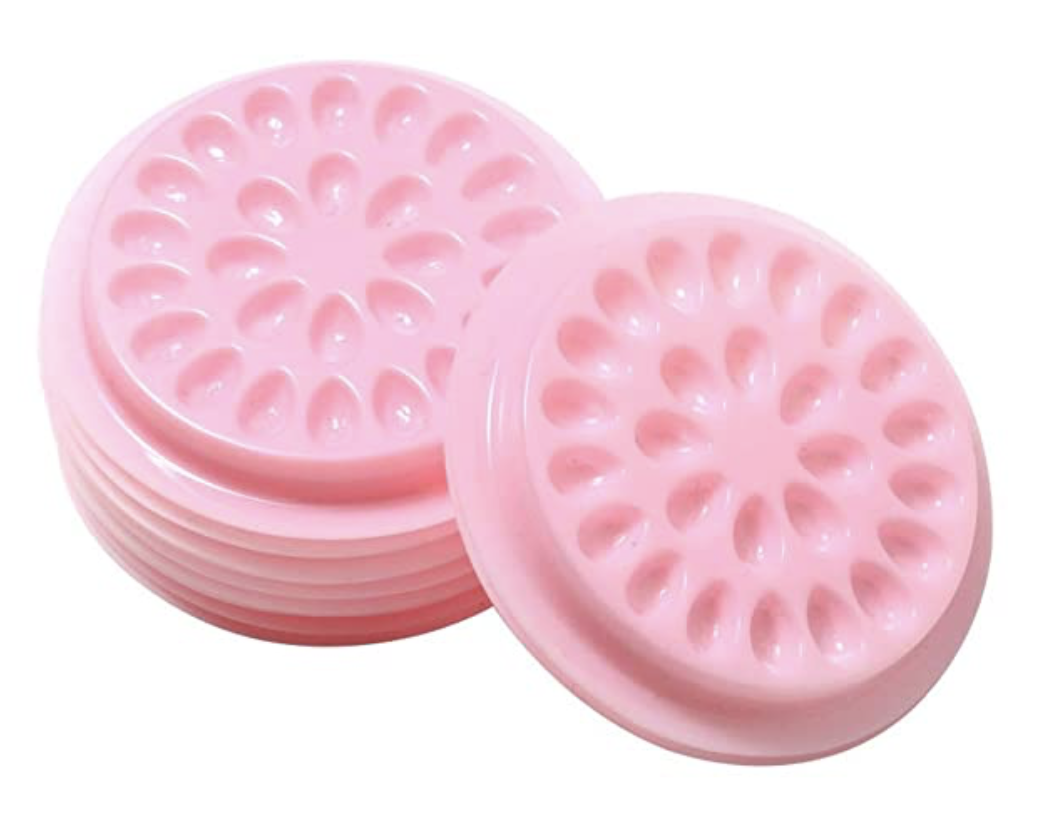
Adhesive Disks/Tray

Adhesive disks/tray are a great alternative to both rings and adhesive stickers. They are disposable, offer multiple adhesive sections, and typically come with a sticker bottom, making your adhesive tray stay solid during application.  These are great for beginners, however can be so large that they can take up too much space on tiles, trays, etc. 

Pros

  • Sanitary (Disposable)
  • Easy accessibility 
  • Adhesive keeps from "running." (Keeping the nice bubble.)
  • Offers multiple spaces for fresh adhesive dots (or if you're working with multiple adhesives) 
  • Comes with a sticker bottom, allowing the tray to stay put during the application. 
  • Lot's of place to wipe off excessive adhesive.
Cons
  • The sections may not be deep enough, but this can make the adhesive possibly dry out quicker depending on a lash techs room set-up. (Temperature, humidity levels, etc.)
  • Some trays can have sections that are too deep, making it difficult to get a visual on how far to dip lashes. 
  • These are so light weight, if they don't come with a sticker bottom, they need to be taped down to make sure the disk itself doesn't lift from the "workplace."
  • Some of these trays can be large, making them take up space on the workplace, trays, tiles, etc.

Adhesive Flowers


Adhesive flowers are universal and great for beginners and more advanced techs. Some can be compatible with glue rings, and others can be treated like glue ring inserts or adhesive trays (they just need a sticker (sticky) bottom.) They are the size of an adhesive sticker, making them a smaller pallet alternative to glue trays/disks. This is one of my favorites. 

Pros
  • Sanitary (Disposable)
  • Glue stays in the pallet. (Keeping the nice bubble.)
  • Offers multiple spaces for fresh adhesive dots (or if you're working with multiple adhesives) 
  • Easy accessibility
  • Perfect sections or cups that aren't too shallow or too deep. 
  • Some can be retrofitted or made for glue rings (glue ring inserts.) 
Cons
  • The cups may not be deep, but this can make the adhesive possibly dry out quicker depending on a lash techs room set-up. (Temperature, humidity levels, etc.)
  • may not fit certain glue rings.
  • If not being used with a ring, these are so light weight, they need to be taped down (double sided tape)  to make sure the disk itself doesn't lift from the "workplace."
  • Because the sections are shallow, the adhesive can slightly run at certain inclines.
  • May not have a lot of areas to wipe off excessive adhesive. 
Adhesive Plates 


I just recently saw these being featured from Bella Lash. They seem to be a great tool for volume and mega volume while have a staging area available on the plate itself. the divots help keep the nice bubble shape for the adhesive. Though, I'm reluctant because I have major concerns when it comes to disinfecting these properly. They recommend acetone, but that is just a level of sanitizing, and not disinfecting. 


Pros
  • Great for beginners and advanced techs. 
  • Designed for volume and mega volume with staging area.
  • Easy accessibility 
  • Multiple adhesive sections "divots"
  • Divots keep adhesive from "running" and drying out. (Keeping the nice bubble.)
Cons
  • I'm not sure what these are made out of, but it looks like plastic? or silicone. These are both porous materials which can't be disinfected properly. They recommend it can fit in their acetone bottle for easy cleaning, but there's no mention of disinfecting. Sanitizing and disinfectant are two separate things. 
  • Somewhat expensive if you use as disposable (for sanitary reasons.)
  • Larger work pallet, can take up more room on lash trays and tiles.
  • These don't seem very heavy, and don't come with a sticker bottom. They need to be taped down to make sure the disk itself doesn't lift from the "workplace."
  • May not have many areas to wipe off excessive adhesive.

Glue Ring - Crystals


Glue ring crystals remind me of the glass crystals that are a alternative to jade stones. I DO NOT recommend these for a few reasons. One is, these may be porous materials, making them impossible to disinfect correctly. the rings themselves can be heavy, bulky, and the adhesive can run. I just find these to be a difficult alternative. 

Pros
  • Easy accessibility.
  • Great platform to wipe off excessive adhesive.
Cons
  • Ring Sizes may vary (and not fit) or be uncomfortable
  • Watch out for depth of the "cup". Some can be too deep. 
  • The adhesive can "run" and dry out quickly. 
  • Impossible to disinfect properly.
  • Heavy, bulky. 
  • Somewhat expensive if you use as disposable (for sanitary reasons.)
Adhesive Stickers (Foil Stickers)


These are basically what most techs began doing lashes with. Great for all techs, especially beginners. The sticker is sanitary, and the foil stickers help keep the adhesive to have a nice bubble. However, I find that since the adhesive isn't in a divot, section or cup, it can dry out faster, needing to reapply. Tech will need to put on a cold surface and a surface that is stable. Unfortunately, techs will also need to be aware of putting the adhesive not on a slope or incline, as the adhesive can run and dry out faster this way. These were somewhat designed for jade stones and crystals, to make a more sanitary station. However,  in my last post, I highly DO NOT recommend jade stones or crystals.


Pros
  • Sanitary (Disposable)
  • Great for beginners
  • Easy accessibility
  • Great platform to wipe off excessive adhesive . 
  • Typically cheap, affordable. 
Cons
  • If you don't have a flat, solid and cold place to put the sticker, the adhesive can run and dry out faster.
  • The platform can be too large of a work area for some. 


Personally, my favorites will always be flower and glue ring inserts. Disk trays and Stickers are always my last resorts. I'm not the biggest fan of trays, plates or rings in general. But to each their own. Every technician has a different style and application technique. ❤️
Have another lash adhesive alternative? Tell me about it in the comments or email me at suitelash@gmail.com.

XO Holly
@SuitelashbyHolly


Tuesday, March 16, 2021

Opinion: Why Lash Jade Stone's should be banned

Jade Stone- Eyelash extension service tool
Eyelash extensions first originated in South Korea. It’s hard to pinpoint what year the service began, but it was as early as the early 2000s. (My guess is between 2000-2004.) The best description and overview of the korean technique is featured in the textbook, “ The essential guide to lash extension technology” by Sophy Merszei & Sophia Navarro. It’s the very first textbook on the subject of eyelash extensions, and has used in eyelash extension trainings/schools (beauty schools) in Texas. If you’re a technician and haven’t read it yet (because unfortunately every state is not regulated) then you need to order this book right now. The book definitely made me learn a few new things, and refresh things I’ve already known. One new thing I learned was jade stones.


Jade stones was one of the first supplies used with the Korean method of early days of eyelash extension services. Jade stones are used to keep the lash adheisve cold (since they are stone) and to keep the adhesive from running and drying out while maintaining it’s “drop” shape. Jade stones appear both smooth and hard at the surface. However, jade in reality is a porous surface, making it difficult or near impossible to keep it sterile. Jade stones helped shape eyelash extension services to what they are today, however I find them to be “out-of-date.” Because of the sanitary issues, I feel that jade should be banned all together. 


Jade stones have definitely competed with other stone alternatives including “crystal” stones and acrylic. And yet, the same issues that jade faces, the alternatives face as well. Eventually, I imagine jade stones will be banned. But currently that’s not the case. Unfortunately, eyelash extensions services in a few states aren’t regulated. To the states that are regulated, most of them have no regulation as who should be qualified other than you must be a licensed aesthetician or cosmetologist. As an example, someone could be a licensed cosmetologist and could offer eyelash extensions though having no current or previous experience and/or training. I know, it’s alarming. Unfortunately, eyelash extension services may not even be taught in beauty schools since certain states have no or little regulation for that either. The industry still has a long way to go. And unitl the state(s) comes around, this is where lash companies can sell lash products or certifications or classes without the proper licensing or without proper understanding of what products should be allowed and what shouldn’t. I feel jade stones is just one example of a product that should be off the market. 


I can think of three seperate reputable lash vendors, that if I were currently to look at their websites, they all currently sell jade stones. Just because brands are carrying them, doesn’t mean that they should. A rebuttal that I received from another tech was, “just use adhesive stickers over the stones. That will help with sanitation.” To me, that’s like putting a sticker over a messy or unsanitary countertop. The stone is not sanitary. Period. How would stateboard react to that in any other situation? It would probably end up in a fine. 


Over the years, I have always had a few jade and crystal stones, but always ended up using the inside of the lash gelpad wrapper. (Free, easy, and sanitary cleanup.) 

But if a tech hasn't done it, now is the time to let jade go for good. Explore other products and be open minded to new adhesive alternatives that are sanitary and in the end, better. 💗

My next post will be about alternatives, so keep your eyes peeled. 🖤


RIP jade 💚


Have any questions? Leave me a comment!


-Holly